Key takeaways
- A VIN check is the fastest way to catch accidents, title brands, odometer fraud, and liens before you pay for a used car
- The full record lives in NMVTIS, the federal database that insurers, salvage yards, and state DMVs are required to report to
- Free tools like NICB and NHTSA cover narrow slices. A paid vehicle history report covers the rest
- Run the VIN before you visit the car. A five-minute check can save you thousands
Before you buy any used car, run a VIN check. It's the fastest way to uncover hidden damage, title issues, mileage fraud, and liens before you pay. A clean-looking title can hide a totaled frame, a washed salvage brand, or a loan the seller never mentioned, and none of that is visible from the driver's seat or a test drive.
This guide walks through exactly how to check a VIN, what each record means, and how to read a vehicle history report without getting lost in jargon.
What a VIN check is
Every vehicle sold in the US has a Vehicle Identification Number - a 17-character code that acts like a fingerprint. It's unique to one car, and it follows that car for life, across owners, states, and title transfers.
A VIN check is the process of entering that 17-character code into a database to pull everything that's been reported about the car. That includes title records, reported accidents, odometer readings, open recalls, theft records, and any salvage or flood brands applied along the way.
You can find the VIN in three places on the vehicle itself:
- Bottom corner of the windshield, on the driver's side, visible from outside
- Driver's door jamb, on a sticker that also lists tire pressures and manufacture date
- Vehicle registration and insurance documents
If any of those three don't match each other, stop there. Mismatched VINs are a serious fraud signal.
Why VIN checks matter
A used car history isn't visible, and a seller who knows about a hidden problem has every reason not to mention it. Always run a VIN check before buying a used car. It surfaces the four categories of damage that cost buyers the most money after the sale.
Accidents. Reported collisions, airbag deployments, and structural damage. A car that was in a serious accident can be repaired to look fine on the outside while hiding frame damage that affects safety and resale value.
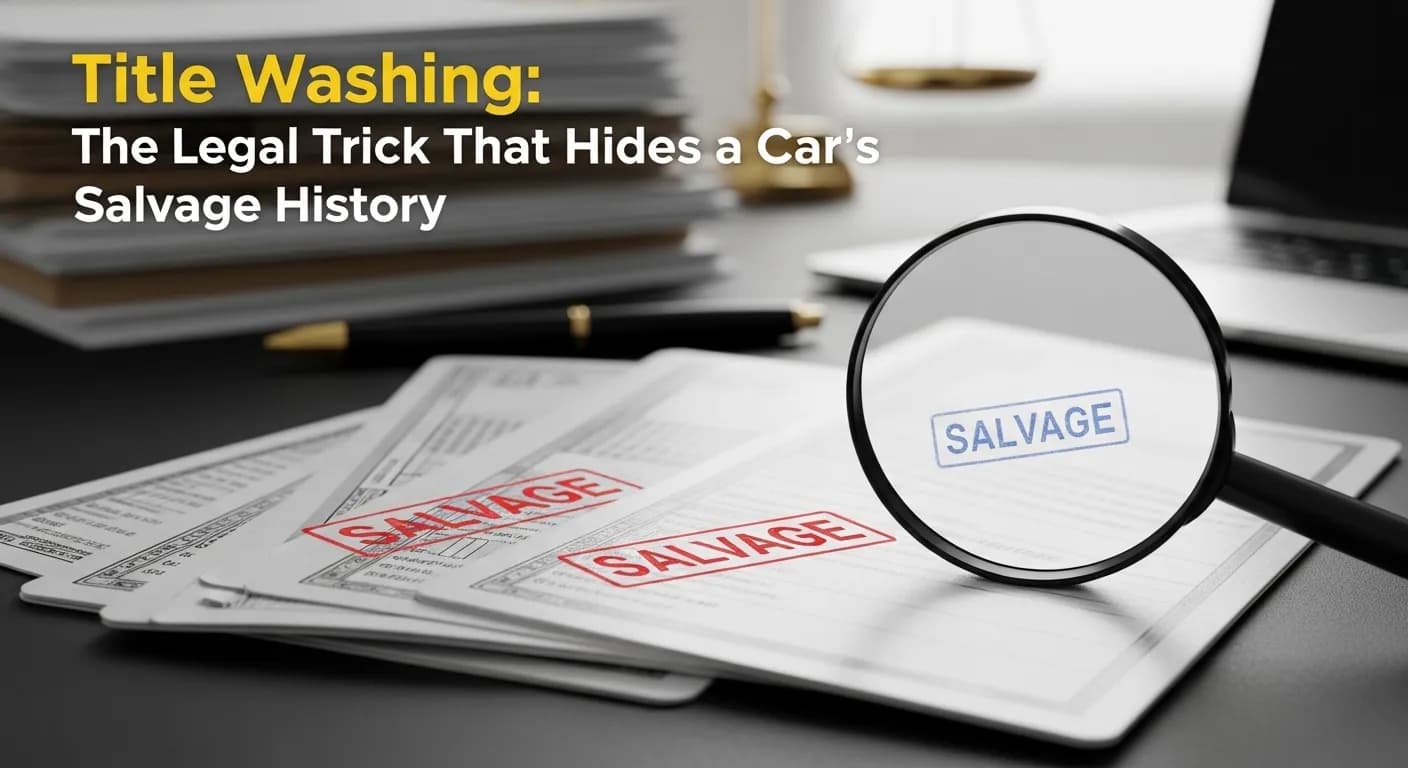
Title issues. Salvage, rebuilt, flood, fire, hail, junk, and lemon law buyback brands. These cut a car's value by 30 to 50 percent and sometimes make it uninsurable or unfinanceable. Title washing - where a branded title is re-registered in a state with looser rules to erase the brand - only gets caught by a report that pulls cross-state records.
Mileage fraud. Rolled-back odometers are still common, especially on vehicles that pass through multiple owners. A history report logs the mileage reading at every title transfer. If a 2020 model shows 80,000 miles at one transfer and 45,000 miles at the next, someone rolled it back.
Liens. An outstanding loan against the vehicle. If the previous owner didn't pay off their financing, the lender technically still owns the car. Buying it without clearing the lien can mean the bank repossessing a car you paid cash for.
Each of these is documented somewhere. A VIN check is how you find it.
Step-by-step: how to check a VIN
Run a VIN check before you visit the seller. Here's the exact sequence to follow for any used car before you commit to buying it.
Step 1: Get the VIN from the seller
Ask in your first message. Any legitimate seller provides it immediately. If a seller hesitates, makes excuses, or sends a partial number, stop the conversation. There is no good reason to withhold a VIN from a serious buyer.
Confirm the VIN is 17 characters. The letters I, O, and Q are never used, so if you see any of those, you have a typo. Double-check the number against the windshield and door jamb once you visit.
Step 2: Run the free safety checks first
Two free federal tools are worth running on every VIN, because they only take 30 seconds each and cover problems nothing else catches.
- NICB VINCheck at
nicb.org/vincheck. Returns stolen vehicle records and insurer-declared total losses. Limited to five lookups per 24 hours. - NHTSA Recall Lookup at
nhtsa.gov/recalls. Returns every open federal safety recall on the vehicle that hasn't been repaired.
Neither of these is a full history check. They catch specific, severe problems (a stolen car, an unrepaired airbag recall) and nothing else. Run them, then move on.
Step 3: Confirm the vehicle identity
Before paying for a full report, confirm the VIN matches the car being advertised. Enter the VIN at VinPanda for free to confirm the year, make, and model of the vehicle. If the listing says it's a 2019 Honda Civic and the VIN returns a 2017 Toyota Corolla, that's the entire deal right there.
This step isn't a history report. It's a quick sanity check that costs nothing and prevents you from paying for a report on the wrong car.
Step 4: Pull the full vehicle history report
This is the part that actually drives the buying decision. A full vehicle history report sourced from NMVTIS returns records across all 50 states in a single document.
VinPanda is a VIN check and vehicle history report service for used car buyers, built to return the key title, lien, and odometer records in seconds. The report costs $14.99, no account and no subscription. The PDF arrives by email within seconds of payment and includes title brand history, lien records, odometer readings logged at each title transfer, reported accidents where available, auction records and damage photos where available, and open recalls.
For most buyers, the critical data - title brands, liens, and odometer history - comes from the same federal NMVTIS record, which is what VinPanda focuses on. Other services like Carfax ($44.99) and AutoCheck layer in proprietary dealer and repair shop data on top of that same federal source, which can be useful but isn't what catches the biggest risks in a used car purchase.
Step 5: Read the report before you visit the car
A report you don't read is a report you wasted money on. Open the PDF, scan for red flags (next section), and decide whether the car is still worth a physical visit. If the report shows a salvage brand, an active lien, or obvious mileage inconsistencies, you save yourself the drive.
What to look for in a vehicle history report
A report is only useful if you can read it. Here's what matters and what each red flag actually means.
Title brands. Any notation other than "clean" or "standard" is significant. Salvage, rebuilt, flood, fire, hail, junk, and lemon law buyback brands all reduce value and indicate prior serious damage. A single brand from any state stays with the car. If the current title is clean but a prior state shows a salvage brand, that's a washed title.
Odometer inconsistencies. Scan the mileage column across title transfers. The numbers should only go up over time. Any decrease, no matter how small, means the odometer was rolled back or misreported. Either way, walk away.
Open liens. An active lien means there's an outstanding loan against the vehicle. Don't buy until the seller provides a lien release document from the lender. If they can't produce one, the bank still has a claim on the car.
Accident records. Look for structural damage, airbag deployment, or multiple incidents. A single minor fender bender isn't necessarily a dealbreaker. Multiple accidents, frame damage, or deployed airbags are.
Auction appearances. Cars that passed through salvage auctions are often repaired and resold as clean. The report should show the auction date, the declared damage, and in many cases photos of the vehicle at the time. If the auction photos show a caved-in front end and the listing photos show a perfect car, ask questions.
Ownership count and geography. A 10-year-old car with 12 owners across 8 states is unusual and worth investigating. Frequent transfers can indicate undisclosed problems that each owner discovered and offloaded.
Open recalls. Not a dealbreaker, but worth knowing about. Unrepaired safety recalls can be fixed for free at any franchise dealer for that brand.
Free vs paid VIN checks: an honest comparison
Here's the real picture, with no sales pitch.
Free tools cover narrow slices. NICB catches stolen and insurer-totaled vehicles. NHTSA catches open safety recalls. State DMV title searches cover records for that one state only, and most states restrict access to the current owner. VinPanda's free step confirms year, make, and model for VIN verification. None of these show the full NMVTIS record.
Paid reports cover the rest. Title brand history across all 50 states, lien records, odometer readings at every title transfer, reported accidents, auction records with damage photos, and cross-state records that catch title washing. This is the data that actually decides whether a used car is worth buying, and it lives behind NMVTIS licensing.
Price does not equal coverage. A $14.99 report from VinPanda pulls the same underlying federal NMVTIS record as a $44.99 report from Carfax. The price difference mostly buys Carfax's proprietary service and repair history network, which can be useful but isn't required for catching title, lien, or odometer problems.
If you do one thing before buying a used car, run a VIN check first. Stack the free tools with a cheap paid report: five minutes of work, roughly $15 of cost, and you've done the same due diligence a reputable dealer would do on their own inventory.
One thing a report won't replace
A vehicle history report tells you what's documented. It doesn't tell you what's physically wrong with the car right now. For any used car purchase above a few thousand dollars, budget $100 to $200 for a pre-purchase inspection by an independent mechanic. The two answers complement each other: the report covers history, the mechanic covers current condition.
Skipping either one turns a used car purchase into a coin flip.
The bottom line
If you take one thing from this guide, take this: run the VIN before you visit the car. Get the number from the seller in the first message, run NICB and NHTSA in under a minute, confirm the vehicle at VinPanda for free, and pull the full report for $14.99 if you want the complete history.
A used car purchase is one of the largest transactions most people make outside a home. Spending $15 and five minutes to check what's actually behind the title is the cheapest insurance in the entire deal.
Run a VIN check before you buy. Enter a VIN at VinPanda to confirm the vehicle for free, then pull the full vehicle history report sourced from NMVTIS for $14.99 if you want the complete record.