Key takeaways
- Title washing lets sellers re-register a totaled car in another state to erase the salvage brand
- It's often technically legal, and more common than most buyers realise
- NMVTIS was built to close this loophole by sharing title records across all 50 states
- A vehicle history report shows the full cross-state title history, not just the current state's record
A car gets totaled in Florida - flooded by a hurricane. The insurance company pays out, stamps the title "salvage," and takes possession of the vehicle. So far, so good.
Now the car gets sold at a salvage auction, shipped to a state with looser title branding rules, and re-registered. The new title comes back clean. No salvage brand. No flood brand. Just a normal-looking title that gives no indication the car was ever written off.
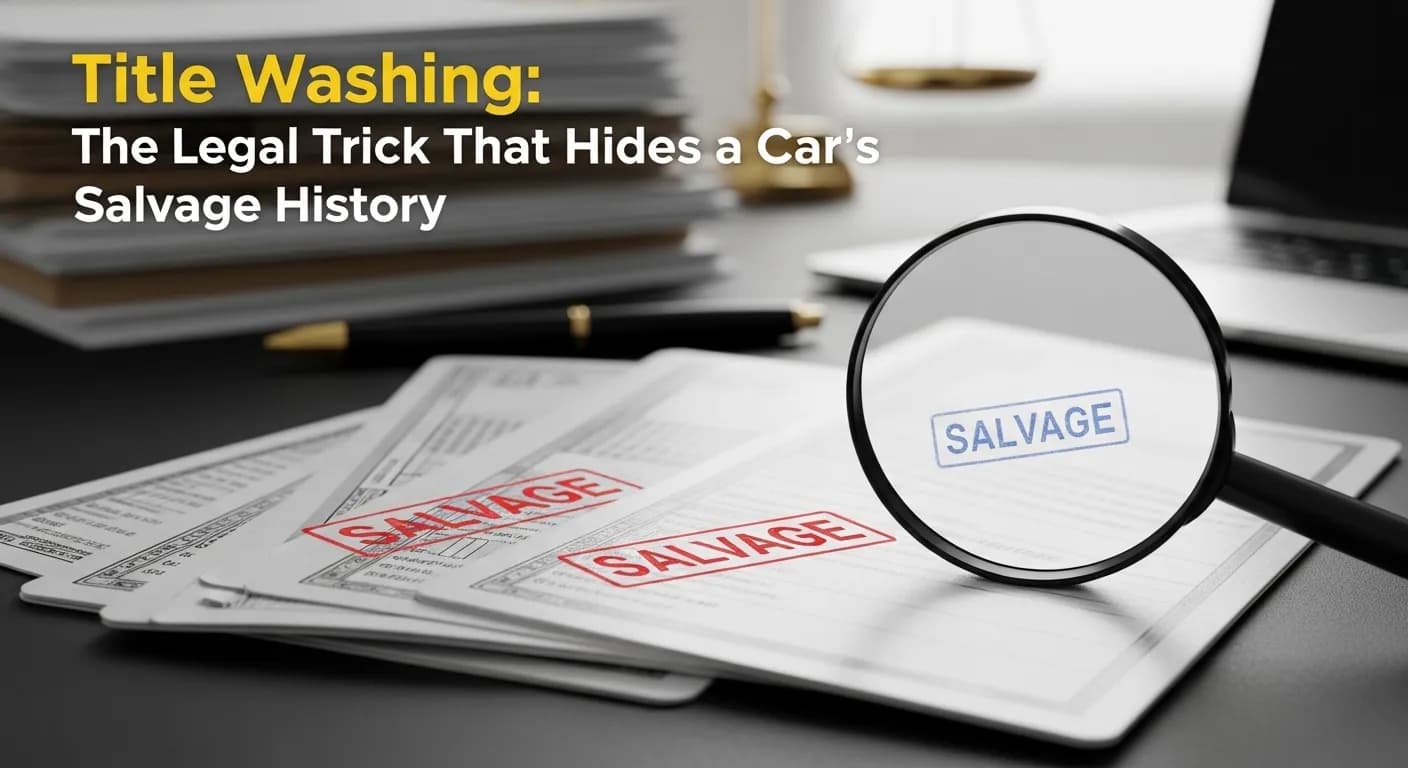
This is called title washing - and in many cases it's entirely legal.
The only way to catch a washed title is to run a VIN check and see the records the seller can't show you. VinPanda is a VIN check and vehicle history report service built on NMVTIS data — enter a VIN and get the full cross-state title history instantly, regardless of what's on the paper title in the seller's hand.
How does title washing work?
When a vehicle is declared a total loss, the state where it's registered brands the title with a permanent notation - "salvage," "flood," "junk," or similar. For a full breakdown of what triggers these brands, see salvage title explained. That brand is supposed to follow the car forever.
The problem is that the US has 50 separate DMV systems, and they don't all communicate perfectly. A handful of states have historically had looser standards for what gets branded and what gets accepted when a vehicle transfers in from another state. This creates an arbitrage opportunity: take a branded title from State A, register it in State B, and receive a clean title in return.
Some states have tightened their rules significantly over the past decade. But the practice persists because it only requires finding one weak link in the chain - one state that will accept a vehicle without applying the prior brand.
What NMVTIS was designed to fix
The National Motor Vehicle Title Information System - NMVTIS - exists specifically to address this problem. Federal law requires all US insurers, salvage yards, and junk yards to report to NMVTIS. Most state DMVs also report title and registration data to the system.
The idea: if a salvage brand from Florida is recorded in NMVTIS, a Vermont DMV clerk checking the system before issuing a new title will see it - regardless of what the physical title says.
In practice, NMVTIS has significantly reduced title washing. But it hasn't eliminated it entirely. Data reporting lags, older incidents that predate NMVTIS participation, and vehicles that moved through non-participating jurisdictions can all create gaps.
What does a vehicle history report show about a washed title?
A vehicle history report from VinPanda pulls NMVTIS data across all 50 states — run a VIN check and the full chain of title records returns immediately. If a car was titled as salvage in Florida, then re-titled as "rebuilt" or clean in Georgia, both records appear - and the Florida brand is visible regardless of what the current Georgia title says. To see exactly how the title chain and brand history are laid out, take a look at a sample report.
This is why a vehicle history report is worth running even on a car with a seemingly clean title. The report doesn't just show the current state - it shows the full cross-state title history, which is the only reliable way to catch a washed title. For a step-by-step guide, see how to check a VIN before buying a used car.
Red flags to watch for
Even before running a report, some patterns should put you on alert:
- Low price for condition - A suspiciously clean car at well below market value is a classic indicator of hidden damage history.
- Out-of-state title or registration - A car that has recently crossed state lines, especially from a flood-prone region, warrants extra scrutiny.
- Recent re-registration - If the car was just re-registered in the current state, ask why it was previously registered elsewhere.
- Reluctance to share VIN - A private seller who resists giving you the VIN before you visit has something to hide.
Which states are associated with title washing?
Title washing isn't tied to one or two states - it exploits the gaps between states. That said, certain patterns come up repeatedly.
Common origin states (where salvage-branded vehicles start): Florida, Texas, Louisiana, and other Gulf and coastal states produce high volumes of flood- and hurricane-damaged vehicles that enter the salvage pipeline.
States historically associated with weaker brand carry-over: Some states have been slower to adopt NMVTIS cross-referencing when processing out-of-state title transfers. The specific states involved have shifted over time as individual legislatures tighten their rules, so naming a fixed list is misleading - the vulnerability is structural, not permanent.
The pattern to watch for is a vehicle that was recently registered in a coastal or disaster-prone state, then quickly re-titled in a different state. Rapid cross-state transfers - especially when the car doesn't appear to have been used in the second state - are the clearest title washing signal. A vehicle history report shows the full chain of state registrations and any brands attached at each step.
Is title washing illegal?
This is where it gets complicated. Title washing occupies a gray area in many jurisdictions.
At the federal level, NMVTIS was created to prevent title fraud, and knowingly misrepresenting a vehicle's title history to a buyer is fraud. If a seller obtains a clean title through a cross-state transfer and then sells the car without disclosing the prior salvage brand, that can constitute fraud under both federal and state consumer protection laws.
At the state level, the act of re-registering a vehicle in a new state is legal. States that don't carry forward out-of-state brands aren't doing anything illegal - they're applying their own titling rules. The illegality comes from the intent to deceive a buyer, not from the title transfer itself.
In practice, prosecutions for title washing are uncommon. The sellers who do it deliberately are difficult to track, often operate across jurisdictions, and may use intermediary buyers or shell entities to distance themselves from the transaction. For buyers, the practical defense isn't legal recourse - it's running a VIN check that shows the complete title history across all 50 states before money changes hands.
How title washing differs from a rebuilt title
A rebuilt title is disclosed: the car was salvage, was repaired, passed a state inspection, and the new "rebuilt" brand appears on the title and in NMVTIS. Some buyers deliberately choose rebuilt title vehicles at a discount because the history is known and priced in.
Title washing is the opposite. The goal is to make the brand disappear entirely and sell the car at full market value to a buyer who has no idea it was ever totaled. For the underlying definition of salvage and the brand types involved, see what is a salvage title.
How to detect a washed title in 6 steps
Run this checklist on any used car before you sign anything. None of it requires the seller's cooperation beyond giving you the VIN.
- Read the 17-character VIN directly off the vehicle at the driver-side door jamb and lower windshield, and confirm both match. Do not rely on a VIN the seller types or screenshots for you.
- Run the VIN through a free VIN check to confirm year, make, and model match the listing.
- Pull the full vehicle history report and read the title section line by line. Every state transfer should be dated and labeled.
- Look for fast cross-state moves. A vehicle that moved from a flood-prone or salvage-heavy state into a different state within months is the classic washing pattern.
- Compare each title's brand field. A salvage or flood brand in one state followed by a clean title in the next is the signal you are looking for, even if the current paper title is clean.
- Cross-check with NICB VINCheck for stolen and salvage records contributed by participating insurers. Independent confirmation costs nothing.
If any step surfaces a brand the seller did not disclose, walk away rather than negotiating. A car priced as clean is not a car priced as rebuilt, and the gap is rarely worth the risk. For more scam patterns to watch for during this process, see our guide to vehicle history report scams and red flags.
Frequently asked questions
Can a clean paper title still hide a salvage history? Yes. The paper title shows the most recent state's record. Title washing works precisely because the new state issues a clean title that does not reflect the prior brand. The full cross-state record lives in NMVTIS, not on the paper.
Does NMVTIS catch every washed title? Most, not all. NMVTIS covers the participating states and reporting entities, and it has narrowed the gap significantly since launch. Older incidents, vehicles moved through non-participating jurisdictions, or recent transfers that have not yet been reported can still slip through. That is why a VIN check plus a physical inspection is more reliable than either alone.
What states are most associated with title washing today? The structural answer is whichever state currently has the loosest rules for accepting out-of-state titles without carrying forward prior brands. The specific list shifts as legislatures tighten rules, so the safer signal is the pattern: a recent cross-state transfer from a coastal or disaster-prone state into a state where the vehicle does not appear to have been used.
Is buying a washed-title car illegal? Buying it is not illegal. Selling it without disclosing the prior brand can be fraud under federal and state consumer protection law. Practical recourse after the fact is slow, which is why the protection is verifying the title chain before you pay.
How is a washed title different from a rebuilt title? A rebuilt title is disclosed and priced in: the salvage record is on the title and in NMVTIS, and the buyer knows what they are getting. A washed title is the absence of disclosure: the salvage record exists in NMVTIS but does not appear on the current paper title.
Will Vinpanda show every prior state title brand? A Vinpanda report pulls the NMVTIS title history across all 50 states, including brands applied at any prior transfer. Reporting timelines vary by state and event, so a very recent brand may not yet appear. The full report is $14.99 with no subscription and no account.
Don't trust the paper title alone. Run a VIN check through VinPanda and get the full report sourced from NMVTIS instantly, cross-state title history included. Check a VIN for $14.99.